Python — automation & data power
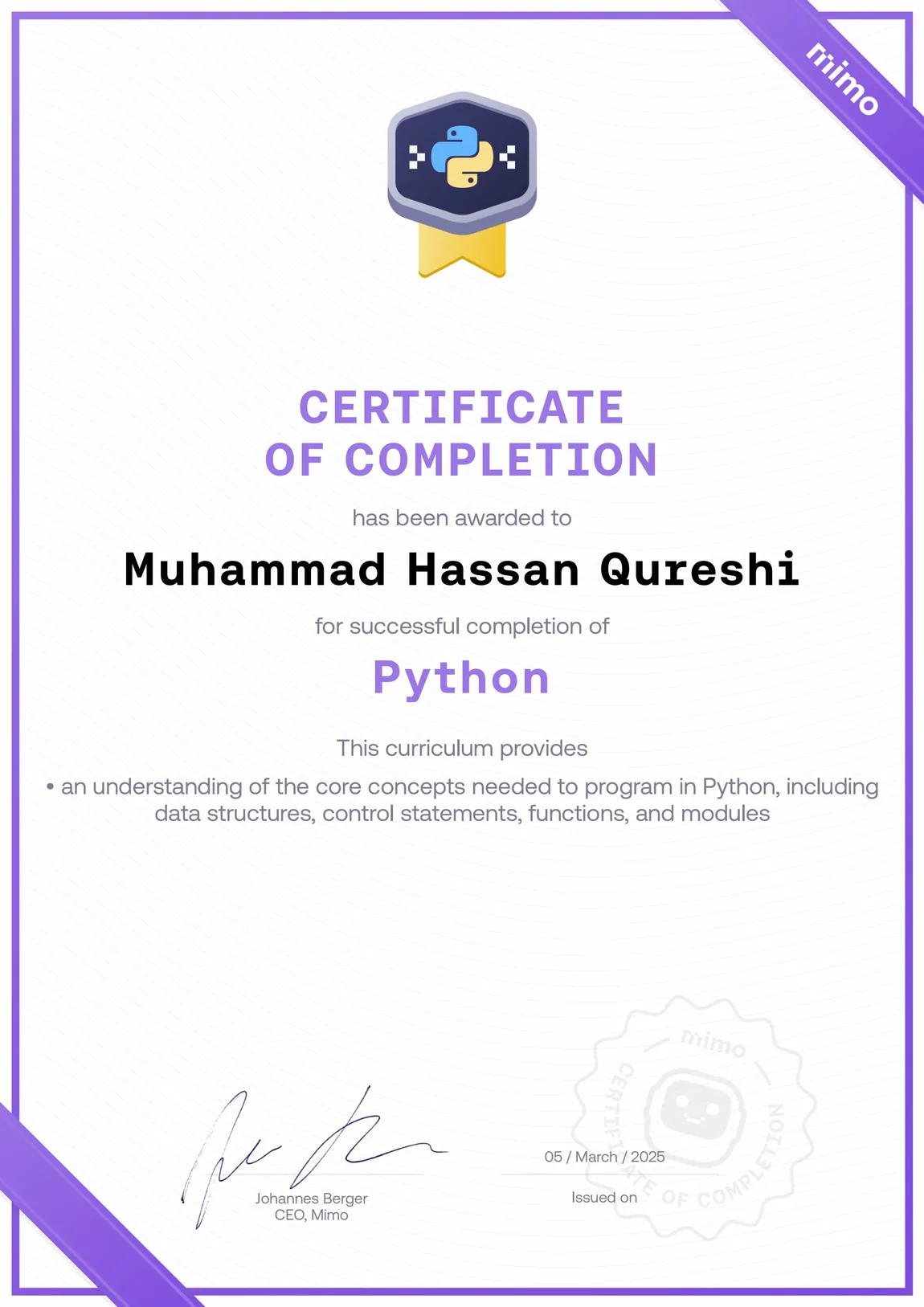
Certified by Mimo in March 2025 — my first technology certificate, earned even before the web stack. Python is the language of automation, data analysis and FinTech, and the natural companion skill of a modern accountant.
§ The language that runs the modern world’s data
Python has a rare distinction: it is simultaneously the friendliest first language for a beginner and the workhorse of serious industry — data analysis, machine learning, artificial intelligence, automation, banking systems and quantitative finance all run heavily on Python. Its syntax reads almost like English, which is exactly why it has become the standard language of the FinTech era.
For me, Python was the strategic first pick. I reasoned that if I was going to learn one programming language deeply as a future accounting and finance professional, it should be the one that speaks data — because data is what finance runs on. Every reconciliation, every analysis of thousands of transactions, every repetitive monthly report that eats an accountant’s week — that is exactly the class of problem Python was born to shrink.
§ How I earned it
I completed the Mimo Python track in March 2025 — my earliest certificate, finished during the heart of my double-diploma years. The course covered the complete foundation: variables and types, control statements (conditionals and loops), functions, and modules — the building blocks that every Python program, from a five-line script to a bank’s analytics pipeline, is assembled from. A particular focus was data structures: lists, dictionaries, tuples and sets — the containers that organise information the way ledgers organise transactions.
Earning it during the DIT added a satisfying symmetry: I was studying database systems and programming concepts in class while practising them nightly on Mimo. The certificate exam consolidated both into one verified credential — and it set the pattern for everything after: HTML, CSS and JavaScript later the same year, each adding a new territory to the same map.
§ Why an accountant should care
Here is the honest professional picture: the parts of accounting that pure repetition — copying, formatting, totalling, reconciling — are being automated first, and Python is frequently the tool doing it. The accountants who thrive in that world are not the ones who hide from code; they are the ones who can frame the problem for automation, check the machine’s work, and spot when the “automatic” answer is quietly wrong. That framing-and-verifying skill is exactly what learning to program builds.
Concretely, the accountant’s Python toolkit is practical: scripts that clean up exported transaction data, that compare two ledger extracts and flag the differences, that turn a folder of reports into one summary, that scrape the daily exchange rates into a sheet. Each is a small program; together they are a career advantage.
§ The bigger picture: FinTech and AI
My interest in Python is inseparable from my interest in FinTech and artificial intelligence — the two forces most visibly reshaping finance. Modern AI is, at its core, data processing at scale, and Python is its native tongue. As I progress through my BS Accounting & Finance degree and toward the ACCA qualification, I intend to keep deepening this side: automation for the routine, analytics for the insight, and AI literacy for the judgement calls that machines cannot make. I have written about exactly this future in my article AI Is Changing Accounting — because it is the future I am actively preparing for, not just predicting.
 click to view full size