Handy Tools — our first shipped product
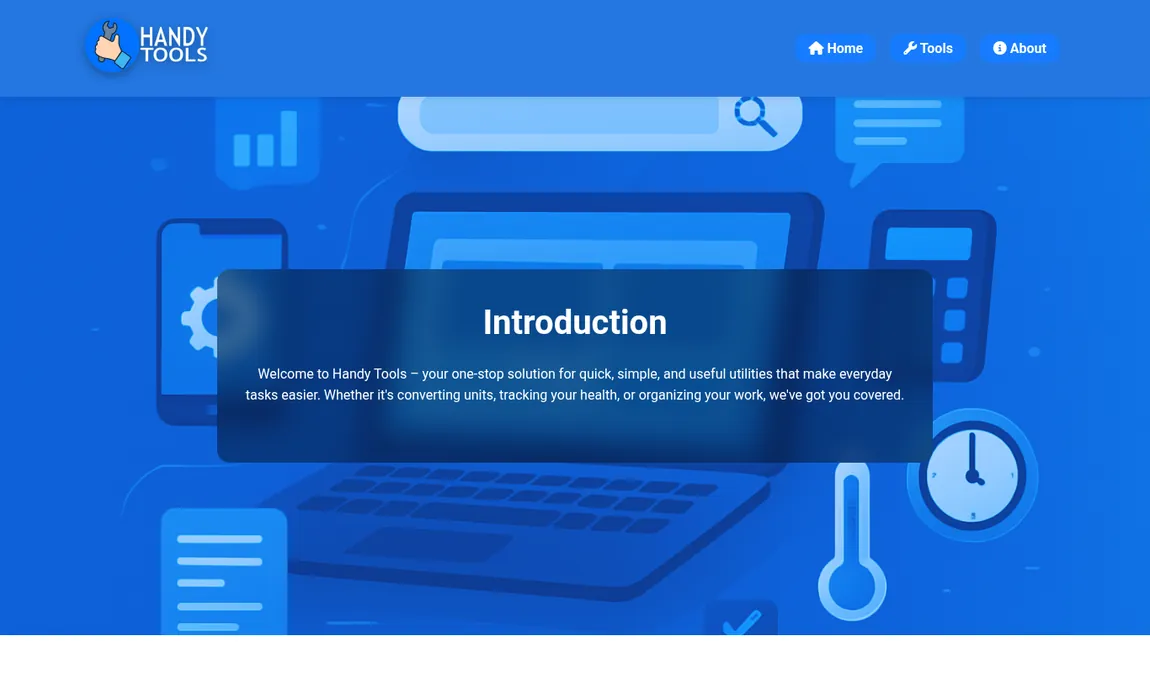
Six everyday web utilities, built with my brother for our DIT final project — and deployed to the real internet. This is the story of how a college requirement became a lesson in modern development, deployment and stubborn problem-solving.
§ The question that started it
Every DIT student reaches the final project, and most reach it with the same quiet dread: build something, submit it, move on. My brother and I — classmates in the same DIT programme, and we made a deliberate decision to be project partners — refused the “something” route. We asked ourselves a different question: what do people actually google in small moments, every single day?
The answers kept arriving: “convert Celsius to Fahrenheit”, “calculate my BMI”, “count the words in this paragraph”, “meters to feet”, “kilograms to pounds”. Small needs, constant demand, and search results full of cluttered, ad-heavy pages. We decided our final project would answer them cleanly — a suite of six everyday utilities, with a simple, honest interface and no clutter. We called it Handy Tools.
§ What we built
Six utilities, each hand-coded in HTML, CSS and JavaScript. The Temperature Converter (Celsius, Fahrenheit, Kelvin), the Length Unit Converter (meters, kilometres, centimetres, millimetres, miles, yards, feet, inches) and the Mass Unit Converter (kilograms, grams, milligrams, pounds, ounces, tons) handle instant conversions with dropdown unit selection. The BMI Calculator applies the WHO-standard formula and interprets the result. The Word Counter tallies words and characters live as you type — a quiet favourite of students and writers. And the To-Do List persists in the browser’s local storage, so your tasks survive the day.
The engineering behind the simplicity was deliberate: real-time calculations, form validation and error handling, a responsive layout tested from wide desktop down to small phone, and one consistent design system across nine pages. The project earned 92 out of 100 as our DIT capstone — and, more importantly, kept working for real users after submission day.
 tools page
 BMI calculator
 length converter
 about page
§ The hosting journey — InfinityFree, Pantheon, and the modern way
Building the tools turned out to be the easy half. The hard education began when we tried to put them on the internet. Our first stop was a traditional free host, InfinityFree — where we ran into its significant technical limitations: forced delays, restricted features and an overall experience that felt anything but professional. Next we tried Pantheon, and again hit walls that a student budget could not climb.
That is when we discovered the approach that changed everything for us: a modern development workflow with GitHub for version control and Vercel for automated deployment. We created a proper repository, pushed our project to it, imported it into Vercel — and suddenly every code update could go live automatically. As our project report put it, that integration became “the cornerstone of our project’s success.”
§ The night of the 404
Then came the night we will never forget. The deployment went live — and the site threw 404 Not Found errors instead of our pages. For a project with a submission deadline, that is the kind of moment that teaches you who you are. We systematically debugged the whole structure and found the culprit: our links used absolute paths, which worked on our laptops but broke on the server. One careful restructure of the repository and a conversion of every path to relative form later, the site loaded perfectly — every page, every asset, every tool working.
§ Why it still matters to me
Handy Tools is modest by ambition and honest by execution — six small tools that work, every day, for anyone who visits. But it was our first: the first time an idea of ours became a live product, the first repo, the first deployment, the first production bug fixed under pressure. Everything that followed — including LearnFinity — stands on the habits Handy Tools built. And it earned its formal recognition too: the project anchored our DIT capstone score and contributed to the excellence awards of that year.
If you are a student reading this with an unbuilt idea: this is the whole secret. Start smaller than your pride wants, ship it, fix what breaks, and let the next project be bigger. It works — we checked.
Try the tools — they’re still live.
Every utility is free, fast and clutter-free. And if you have an idea you keep postponing, you know my advice already — let’s talk about how to start it.