CSS — design & layout craft
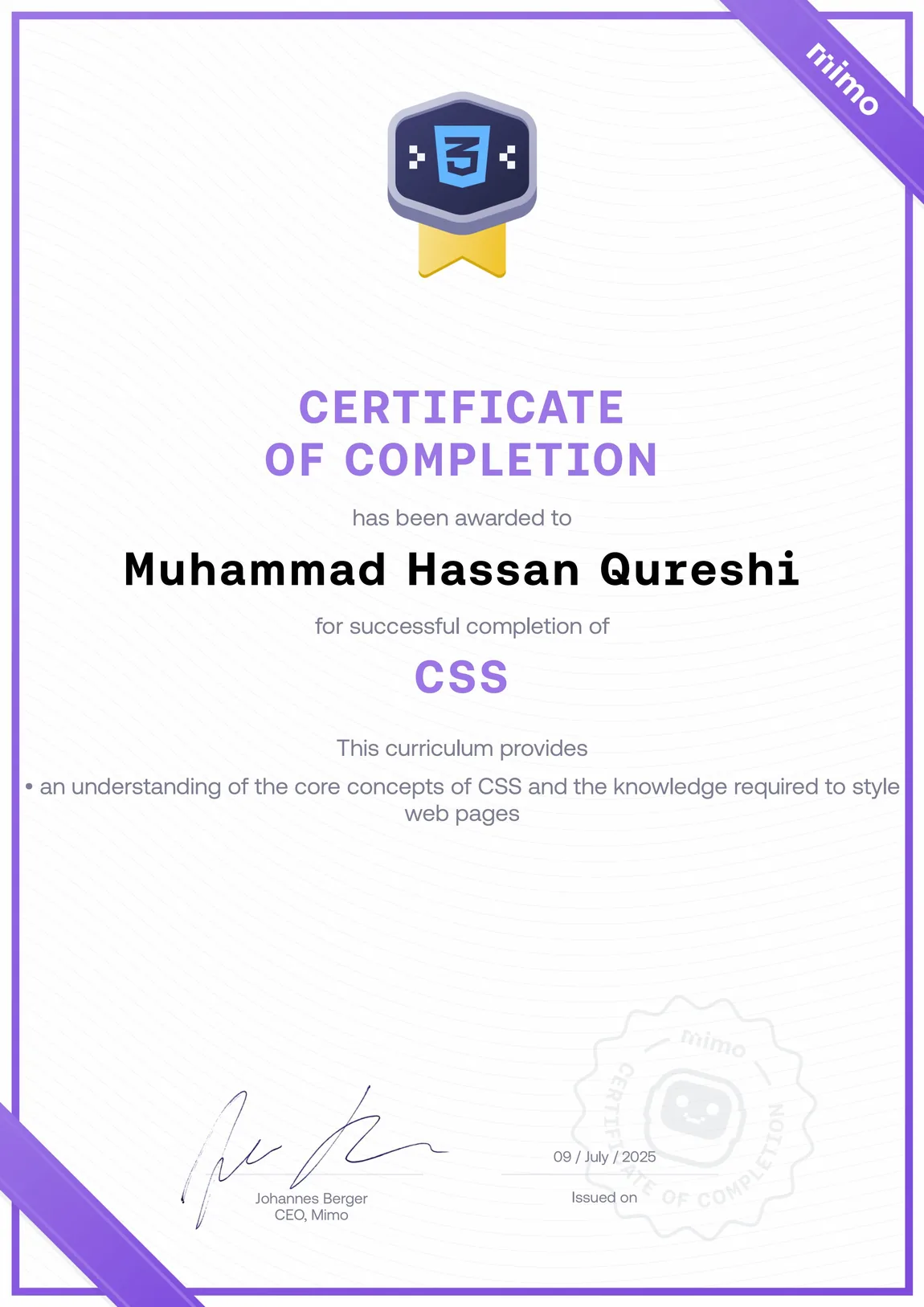
Certified by Mimo in July 2025. HTML is the skeleton; CSS is everything you actually see — layout, colour, spacing, responsiveness and animation. It is where engineering meets visual design.
§ The invisible half of every interface
Open any website and mentally remove the colours, the fonts, the spacing, the multi-column layouts, the hover effects and the way it reshapes itself perfectly for your phone. What remains — grey text on a white scroll of eternity — is the web without CSS. Cascading Style Sheets is the language that transforms raw structure into designed interface, and its share of a modern website’s code is usually larger than the HTML itself.
What draws me to CSS is that it is simultaneously logical and aesthetic. Its core ideas — the cascade, specificity, inheritance — are rule systems as strict as accounting standards: given a set of declarations, the outcome is deterministic and traceable. On top of that strictness sits a creative craft: choosing type scales, building rhythm with spacing, guiding the eye through hierarchy. Few skills train both hemispheres at once; CSS is one of them.
§ How I earned it
I completed the Mimo CSS track in July 2025, immediately after finishing the HTML track — the two are designed to be learned in sequence, and the pairing worked exactly as intended. The course moved from selectors and the box model — the deep concept that every element on a page is a box with content, padding, border and margin — through Flexbox and Grid, the two layout systems that modern interfaces are built on, and into transitions, animations and responsive design with media queries.
The Mimo method kept every lesson hands-on: no slide decks, just a code editor and instant results. That suits how I learn anything — including accounting. Rules are remembered when they are applied, not when they are read. I finished the track with the same conviction I take from double-entry bookkeeping: master the system’s logic once, and thousands of specific cases resolve themselves.
§ Where I have used it
CSS was half the work in Handy Tools. Six tools, each with its own interface: dropdowns for the unit converters, sliders and result cards for the BMI calculator, a live word counter, a to-do list that saves itself. Every one of those interfaces had to be laid out, spaced, coloured and made responsive — from a wide desktop screen down to a small phone — and every one of those decisions was CSS. The project also taught me the unglamorous truth of the craft: the tenth browser-quirk you fix teaches more than the first ninety lessons of any course.
This portfolio is the fuller demonstration — dark emerald and gold theme, glass panels, animated charts, this very two-column layout with its sticky sidebar. Built with the same certified fundamentals, applied at larger scale.
§ What I teach
In my tech sessions, CSS is where students get genuinely excited — because it is the session where their plain HTML page suddenly becomes something they are proud to show. We cover the box model, one practical layout pattern, and colour and type basics. Modest scope, deliberate outcome: by the end, a business student can build a clean, professional-looking page — and understands, permanently, why some business documents look credible and others do not.
 click to view full size