JavaScript — the language of the browser
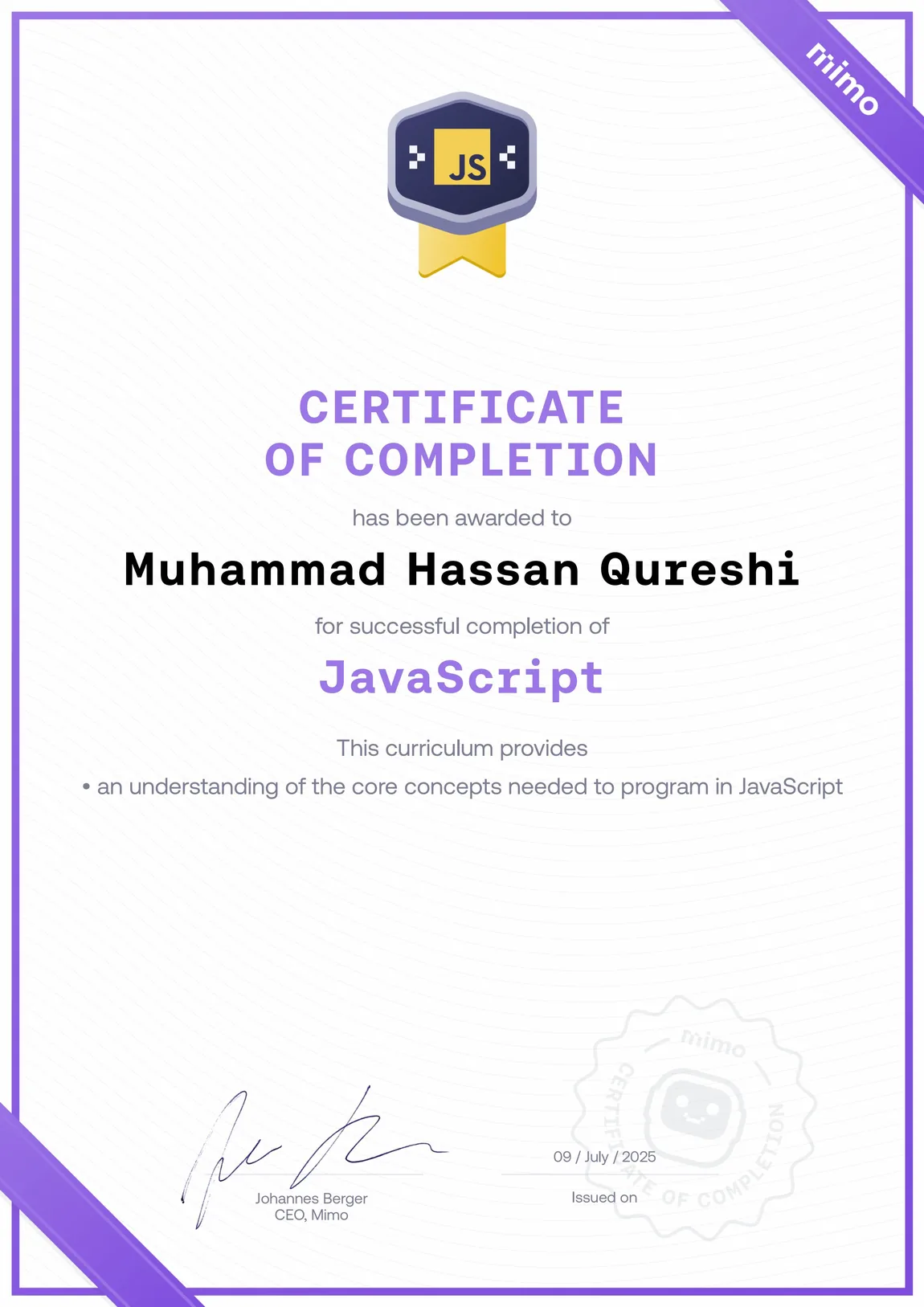
Certified by Mimo in July 2025. HTML structures a page, CSS designs it — JavaScript makes it think. Every calculator, converter and live update you have ever used on the web runs on JavaScript.
§ Where structure becomes behaviour
JavaScript is the only programming language every browser on Earth understands natively, and that single fact makes it one of the most consequential technologies ever created. When a converter updates as you type, when a form refuses an invalid email instantly, when a chart animates as you scroll to it, when a to-do list remembers what you added yesterday — that is JavaScript at work: reading the page, making decisions, and rewriting it in real time.
Conceptually, JavaScript is where “web pages” became “web applications.” It brings the full toolkit of programming — variables, conditionals, loops, functions, arrays and objects — into the browser, and pairs them with the DOM (Document Object Model), the live map of the page that scripts can read and modify. My Mimo course covered exactly this span: language fundamentals on one side, DOM manipulation and events on the other.
§ How I earned it
I completed the Mimo JavaScript track in July 2025, as the third step of my self-designed sequence — HTML, then CSS, then JavaScript. The ordering matters: by the time I began, I could structure and style a page, so every JavaScript lesson immediately had a canvas to run on. The course drilled the essentials — types and operators, control flow, functions, arrays and objects, and then the satisfying part: selecting elements, listening for clicks and key presses, and updating the page in response.
What surprised me most about JavaScript was how familiar its logic felt. A conditional is a decision rule; a loop is a repeated journal posting; a function is a reusable procedure, exactly like a well-documented accounting process. Programming, it turns out, is bookkeeping for machines — every value accounted for, every case handled, nothing left to chance.
§ Where the certificate paid off
Within weeks of certification, JavaScript became the engine of Handy Tools. Every one of our six utilities is a JavaScript program: the temperature, length and mass converters run live calculations on input events; the BMI calculator applies the WHO formula and classifies the result; the word counter tallies characters and words as you type; and the to-do list uses the browser’s local storage — a small JavaScript-managed database — so tasks survive page reloads. None of it would exist as a working product without this certificate’s material.
On LearnFinity, the stakes scaled up: timed tests, question palettes, score tracking and analytics. The thinking is identical — state, events, validation, feedback — only larger. JavaScript certification was the foundation that made contributing at that level possible.
§ What I teach
In my tech sessions, I teach JavaScript as the first “real” programming experience: variables, decisions, loops and a first interactive page — usually a working calculator or converter, because building a calculator is uniquely satisfying for accounting students. The goal is not a career change; it is a mindset change. After one working program, spreadsheets, macros and even ERP logic stop being magic and start being readable.
 click to view full size