HTML — the skeleton of the web
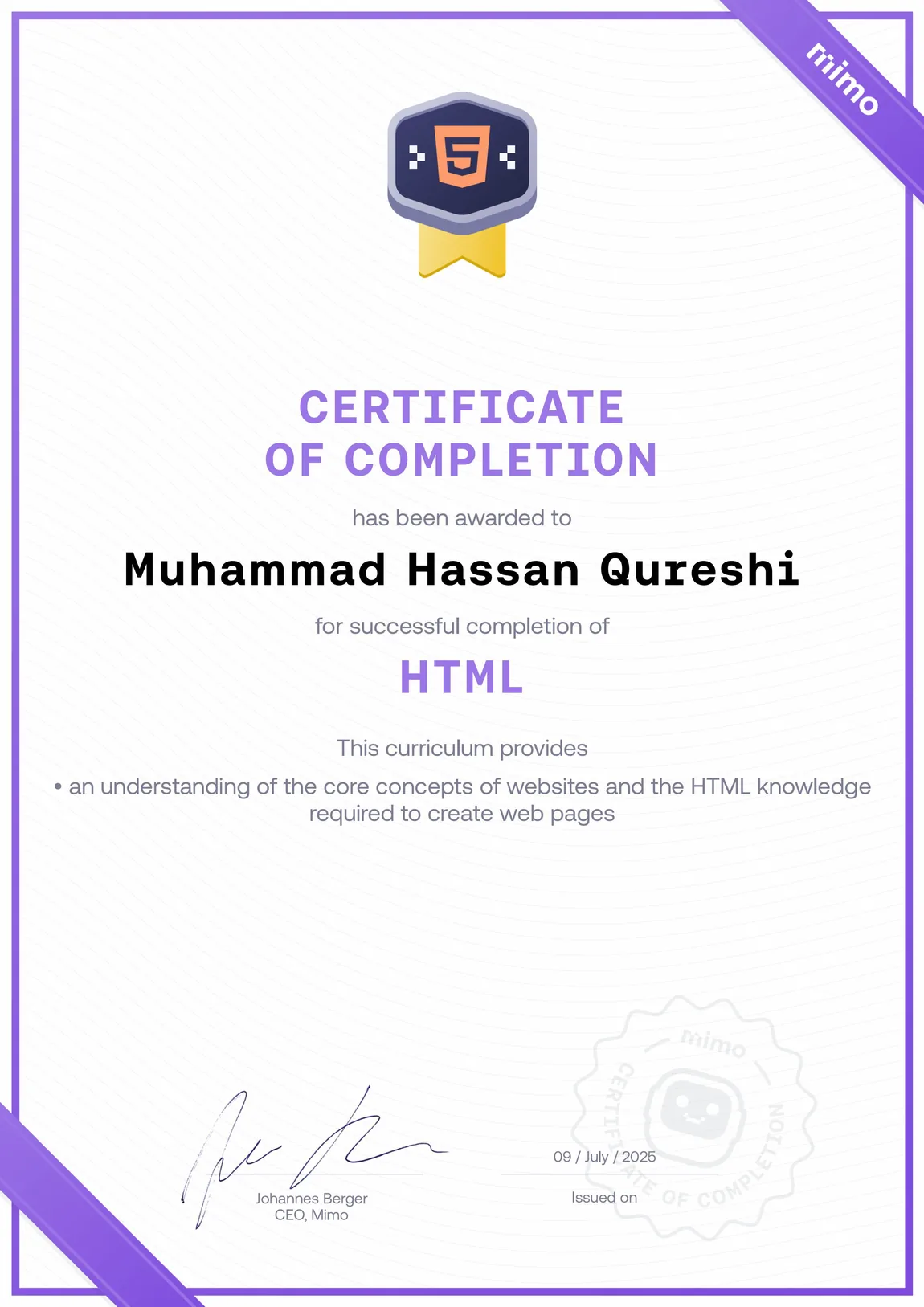
Certified by Mimo in July 2025. Every website you have ever visited — including this page — is built on HTML. For an accountant eyeing FinTech and web-based systems, this is where the technology stack begins.
§ What HTML actually is
HTML — HyperText Markup Language — is not a programming language; it is a structure language. It describes what a page is: this is a heading, this is a paragraph, this is a list, this is a table, this is an image, this is a link. The browser reads that structure and builds the page you see. Without HTML there is no page at all — only text floating in a void.
People sometimes dismiss HTML as “the easy one” of web technologies. It is true that you can write your first valid HTML page within an hour — that accessibility is a design triumph, not a weakness. But there is a deep difference between HTML that merely renders and professional HTML: semantic elements that tell machines what each part means, accessibility attributes that let screen readers describe the page to visually impaired users, and structures that search engines can understand and rank. That professional level is what my Mimo certification course trained and tested.
§ How I earned it
I earned this certificate through the Mimo learning platform in July 2025 — completing its full HTML track, from document structure and text elements through links, images, tables, forms and semantic layout containers. Mimo’s method suited me: short interactive lessons, immediate practice in the browser, and quizzes that refuse to let you coast. I finished the track alongside my DIT coursework, which meant the theory from class and the hands-on practice reinforced each other the same week.
That timing was deliberate. My DIT programme had introduced web development essentials — where I scored 80/100 — and I wanted the fundamentals locked in properly rather than half-remembered. The certificate was the accountability: a fixed target, an exam, and proof at the end.
§ Where I have used it — for real
HTML stops being theory the moment you ship something. In the Handy Tools project, my brother and I hand-wrote every page: the homepage, the tools listing, six separate tool pages — temperature and unit converters, the BMI calculator, the word counter and the to-do list. Structure decisions we made in HTML — clean semantic pages, consistent containers for the tools, well-organised forms — are a big part of why the site has worked reliably since deployment.
This very portfolio is the second proof: every page you can browse here is hand-structured HTML — no site builder, no template. And looking ahead, HTML matters to my profession directly: every ERP screen, every accounting dashboard, every FinTech app and every bank portal is rendered from HTML. The accountant who can read it can never be locked out of understanding the systems that run his field.
§ What I teach
In my tech-for-accounting sessions, HTML is session one — not because everyone should become a web developer, but because four hours of HTML permanently demystifies “the internet” for a business student. When you have built a page with your own hands, every subsequent technology conversation loses its intimidation factor. That single shift in confidence is worth more than any specific technique.
 click to view full size