AccountingCoach — The Accounting Equation
Assets = Liabilities + Equity. Five words that every balance sheet, every audit and every lending decision quietly depends on — certified by examination, and the first of my two AccountingCoach achievements.
§ Why this equation deserves an exam of its own
Most people meet the accounting equation once, in an introductory class, and never think about it again. Accountants think about it every single day. Assets = Liabilities + Equity is not one formula among many; it is the identity that the entire double-entry system exists to protect. Every journal entry, every adjustment, every closing entry either preserves that balance or reveals that something is wrong. When auditors say the books “balance”, this is the equation they mean.
That is why I chose it as the subject of a dedicated professional certification, alongside my debits-and-credits certification. The two are a matched pair: one certifies the grammar of recording transactions, the other certifies the reason that grammar works. Together they cover the logical core of bookkeeping — tested not by a college internal exam, but by AccountingCoach LLC, the platform founded by Harold B. Averkamp, CPA, MBA, whose materials on these fundamentals are used by learners worldwide.
§ What the exam covered
The Introductory Accounting & Bookkeeping examination — topic: the accounting equation — asked what the identity means in practice. How the three parts are defined: assets as what a business owns and controls, liabilities as what it owes to others, and equity as the residual claim that remains for its owners. How every transaction moves at least two of them at once — borrowing cash increases an asset and a liability together; earning revenue increases an asset and equity together — so the equation stays in balance by design, not by luck.
It also covered the connection to the statements readers actually see. A balance sheet is simply the accounting equation arranged on a page, dated and classified. I unpack exactly that relationship in my article The Balance Sheet: A Snapshot of Business Health — written, like everything I teach, in plain language for people meeting the idea for the first time.
§ Where it sits in the plan
I am studying BS Accounting & Finance at IMSciences Peshawar with the ACCA qualification as the destination. Between college and that destination, professional certifications are how I make the fundamentals portable — provable to a tutor, an employer or a client, not just to an examiner. The equation is also the bridge to the ideas I am most curious about next: how GAAP, IFRS and IAS standards shape what may enter the equation, and how blockchain-era triple-entry accounting would change who verifies that it balances.
And in daily work the equation is a habit of mind. When I look at any business — a shop, a startup, a college society’s budget — I instinctively ask the three questions the equation asks: what does it own, what does it owe, and what is that difference worth?
§ What I do with it
In my tuition sessions, the equation is where I begin with every new student, because everything else attaches to it. Students who can explain why a transaction keeps the equation balanced never have to memorise rules blindly; they can derive them. That single shift — from memorising to deriving — is the difference between accounting as a stressful subject and accounting as a satisfying one.
That is the practical return on this certificate: a certified foundation, a teaching tool that works, and a lens I now cannot switch off.
§ The certificate
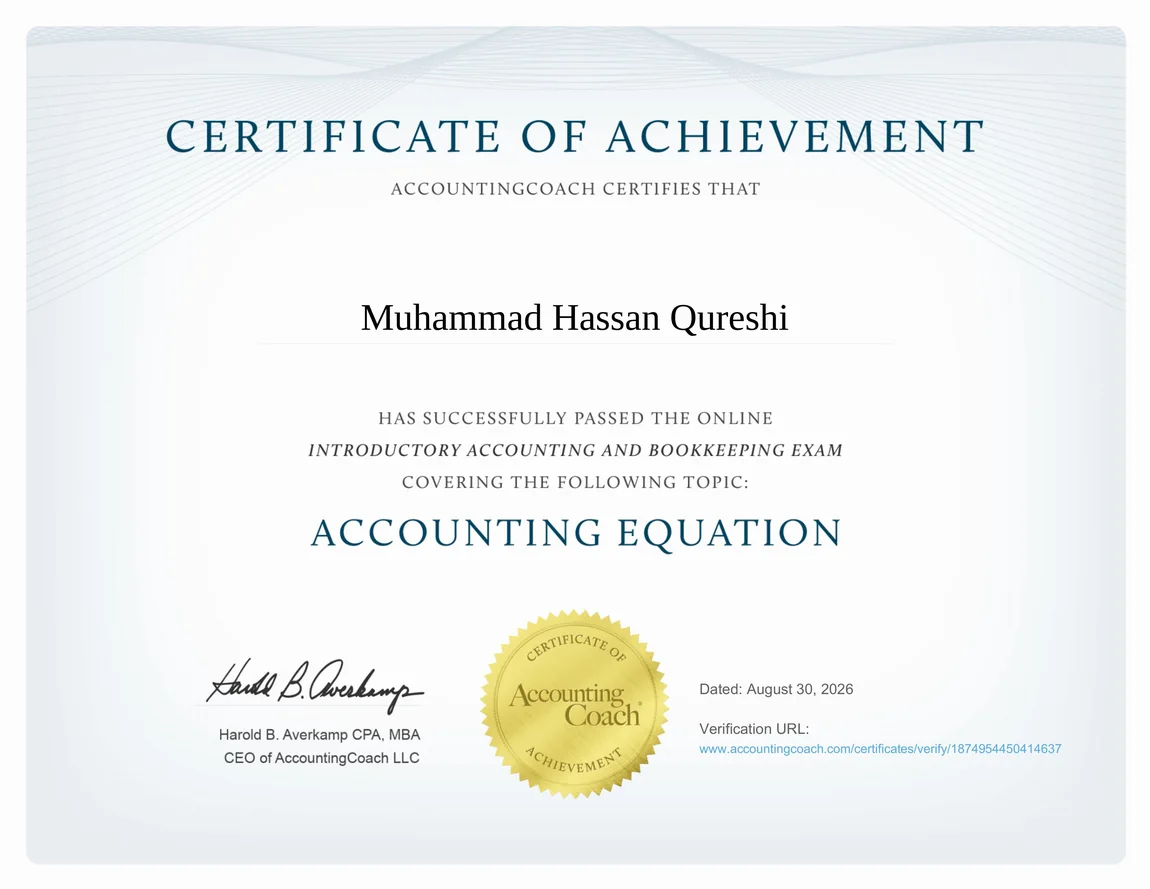
Certificate of Achievement — Introductory Accounting and Bookkeeping, topic: the Accounting Equation · AccountingCoach LLC · 30 August 2026 · Credential ID 1874954450414637 · signed by Harold B. Averkamp, CPA, MBA. Verify at accountingcoach.com/certificates/verify/1874954450414637.
 click to view full size